
The Complete Guide to Jewel Orchids: Care, Terrariums, Planting & Growing
Jewel orchids are unlike most orchids you see in garden centres.
While orchids such as Phalaenopsis are famous for their flowers, jewel orchids are grown primarily for their foliage. Their leaves can be velvety black, deep green, burgundy or chocolate, traced with intricate veins of gold, silver, copper, pink or red.
And despite their exotic appearance, many jewel orchids can be surprisingly easy to grow once you understand one important fact:
They are forest-floor orchids.

That changes almost everything.
They generally don't want the bright conditions given to many flowering orchids. They don't want their roots sitting in stagnant water either. They don't need to dry out like a cactus, and they don't need to be constantly misted.
What they really want is something much closer to a tropical forest floor:
shade or subdued filtered light + warmth + humidity + evenly moist but aerated growing material + gentle air movement.
This is also why jewel orchids can be so spectacular in terrariums.
A glass terrarium allows you to create a miniature forest environment where the humidity remains high and the plants can spread naturally across moss, bark and the forest-floor substrate.
This guide covers the major jewel orchid groups, how their requirements differ, how to grow them in pots, how to build a terrarium specifically for them, and how to avoid the mistakes that cause most jewel orchids to fail.
What Exactly Is a Jewel Orchid?
"Jewel orchid" isn't a single botanical group.
It is a common name used for several mainly terrestrial orchid genera that are particularly valued for their decorative foliage.
Common examples include:
Zeuxine
Nervilia
They are generally associated with the forest floor, where they grow in leaf litter, humus, moss and loose organic material rather than hanging from tree branches like many of the orchids sold as houseplants.
This distinction matters.
A Phalaenopsis is an epiphytic orchid.
A jewel orchid such as Ludisia discolor is terrestrial.
So although both are orchids, they don't necessarily want the same:
light
substrate
watering
planting method
humidity
airflow
Treating a jewel orchid like a miniature Phalaenopsis is one of the easiest ways to get its care wrong.
The Jewel Orchids You Are Most Likely to Encounter
Different jewel orchids have different personalities.
This is particularly important when designing a terrarium.

Common names: Jewel orchid, Ludisia
Ludisia discolor is probably the best-known jewel orchid and one of the most forgiving.
Its leaves are dark green to almost black, with attractive pink, red or gold-coloured veins depending on the form.
It is a creeping terrestrial orchid and can eventually form a substantial spreading plant.
General characteristics
relatively adaptable
terrestrial
creeping growth
enjoys humidity
tolerates somewhat drier conditions than some jewel orchids
relatively tolerant of indoor conditions
excellent terrarium subject
The RHS recommends growing Ludisia in a shallow pot and describes an airy position with good humidity and a well-drained growing medium.
For beginners: one of the best jewel orchids to start with.

Macodes petola is one of the plants people usually imagine when they hear "jewel orchid".
Its dark leaves are covered with spectacular metallic veining that can appear almost fluorescent under the right conditions.
It generally appreciates:
subdued light
high humidity
stable warmth
consistently moist but aerated substrate
gentle airflow
It is less forgiving of drying out than Ludisia.
A terrarium can therefore be particularly useful.
Important
Don't put Macodes petola directly beside a sunny window simply because you want to make its colours brighter.
Its natural environment is a shaded forest floor.
Too much light can bleach the foliage and damage the leaves.
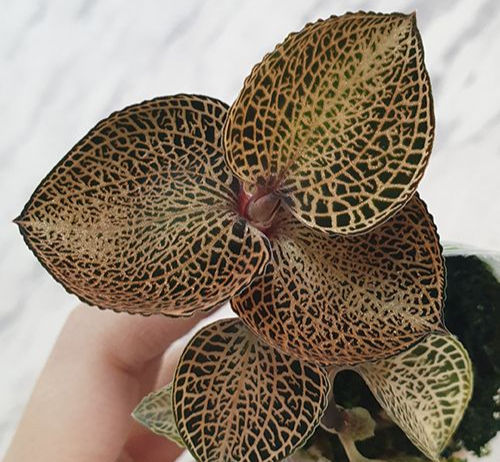
The genus Anoectochilus contains some spectacular jewel orchids.
Anoectochilus discolor, for example, has dark velvety foliage with contrasting red or gold veins.
The RHS lists Anoectochilus discolor for partial shade, with well-drained conditions and an airy position.
These are excellent candidates for humid terrariums.
Compared with the tougher Ludisia, however, many Anoectochilus should be treated as plants that appreciate a more stable environment.
Avoid:
harsh light
prolonged drying
waterlogged substrate
stagnant conditions
large temperature fluctuations

4. Dossinia
Dossinia is another beautiful jewel orchid group, including plants such as Dossinia marmorata.
The foliage can have extraordinary metallic patterning.
These are best approached as humid, shaded terrestrial orchids.
A terrarium or controlled indoor growing environment can work particularly well.

5. Goodyera
Goodyera is a broader group containing many terrestrial orchids, including attractive foliage forms commonly called jewel orchids.
Their requirements vary considerably between species.
Some are more temperate than the tropical jewel orchids commonly sold for terrariums.
This is important:
Don't assume every plant labelled "Goodyera" belongs in a warm tropical terrarium.
Always identify the species where possible.
6. Zeuxine
Zeuxine contains terrestrial orchids, some of which are grown primarily for foliage.
Again, species matter.
Some can be suitable for terrarium cultivation, but they shouldn't automatically be treated as interchangeable with Ludisia.
7. Nervilia
Nervilia is particularly interesting because many species have a different growth cycle from the evergreen jewel orchids people normally associate with terrariums.
Some produce leaves seasonally and can enter dormancy.
This is a good example of why the label "jewel orchid" isn't enough to determine care.
Know the species.
Jewel Orchid Light: The Most Commonly Given-Wrong Advice
This deserves its own section because generic orchid-care advice can be misleading.
Jewel orchids are generally not high-light orchids.
Many are adapted to life on the forest floor beneath a tropical canopy.
They receive filtered, diffuse light rather than direct tropical sunshine.
For most commonly cultivated jewel orchids, aim for:
low to moderate, filtered light.
Think:
bright enough to grow, shaded enough to protect the foliage.
Not:
put it on the brightest windowsill in the house.
The RHS lists Anoectochilus discolor for partial shade and specifically identifies a north-facing aspect as suitable.
This is a very different situation from Phalaenopsis, for which the RHS recommends bright light while avoiding strong direct summer sun.
A useful comparison
Orchid | Typical light preference |
Phalaenopsis | Bright filtered/indirect |
Ludisia discolor | Low-moderate filtered light |
Macodes petola | Low-moderate shaded light |
Anoectochilus | Low-moderate / partial shade |
Dossinia | Shaded, filtered conditions |
Goodyera | Species dependent, generally filtered/shaded |
Nervilia | Species dependent |
These aren't absolute measurements. Individual plants and growing environments vary.
But they are a much better starting point than treating all orchids as requiring bright indoor light.
What Does "Good Light" Actually Look Like?
A jewel orchid shouldn't be sitting in darkness.
There is a difference between:
shade
and
no useful light.
A good location might be:
several feet from a bright window
behind a sheer curtain
beneath other plants
on a north/east-facing windowsill where direct sun is limited
underneath appropriately positioned grow lighting
inside a terrarium illuminated from above
The foliage should remain strongly coloured and the plant should continue producing healthy new growth.
If the leaves become bleached or develop pale patches, the light may be excessive.
If the plant becomes stretched, weak and produces unusually large gaps between leaves, it may need more light.
Artificial Lighting
Jewel orchids can grow extremely well under artificial lighting.
This can actually be easier than trying to find the perfect window.
The important thing is not to assume that a powerful grow light needs to be placed directly above the plant.
A moderate LED positioned appropriately can provide plenty of usable light.
Plants naturally adapted to shady forest floors can be maintained under relatively modest artificial lighting; the RHS specifically discusses low-light forest-floor plants being grown successfully under artificial lighting in terrariums.
If using artificial lighting:
place the light above the terrarium
avoid excessive intensity
use a timer
provide a dark period
monitor the foliage
adjust distance rather than automatically increasing power
Temperature
Most tropical jewel orchids appreciate warm, stable conditions.
A typical indoor environment can work very well.
Avoid:
cold draughts
sudden temperature changes
cold glass during winter
radiators
heaters
hot air from vents
intense heat inside a sunlit terrarium
The exact minimum temperature varies by species.
This is particularly important with Goodyera and other genera containing temperate species.
Never assume that because a plant is called a jewel orchid it automatically wants tropical temperatures.
Check the species.
Humidity
High humidity is useful for many jewel orchids, particularly Macodes, Anoectochilus and similar tropical species.
But here's the important part:
Humidity does not compensate for poor roots.
A plant can sit in 90% humidity and still die if its roots are permanently saturated and oxygen-starved.
Think of the target as:
humid air + moist substrate + oxygen around the roots.
Not:
maximum humidity + maximum water.
A terrarium is useful because it can maintain humidity without requiring the roots to remain submerged.
Do Jewel Orchids Need Misting?
No.
Misting is often presented as an essential part of orchid care when it isn't.
If your terrarium already maintains high humidity, repeated misting may simply add unnecessary water.
Misting can also leave foliage wet for extended periods in stagnant conditions.
Instead, focus on:
appropriate humidity
suitable substrate
correct watering
airflow
If the environment is dry, improve the environment rather than relying on constantly spraying the plant.
Watering Jewel Orchids
This is another area where generic orchid advice can cause problems.
The goal is consistent moisture without saturation.
Many jewel orchids prefer their growing medium to remain more evenly moist than epiphytic orchids.
However, "moist" doesn't mean:
waterlogged
muddy
permanently saturated
sitting in a tray of water
The roots need oxygen.
Ludisia
Ludisia discolor is relatively forgiving and can tolerate the growing medium drying somewhat between waterings.
The RHS specifically advises allowing the compost to dry between waterings.
Macodes and Anoectochilus
These are generally better treated as plants that prefer more consistent moisture.
Avoid allowing the root zone to become bone dry for extended periods.
This distinction is important.
Rather than giving every jewel orchid the same watering schedule, learn the plant.
The Finger Test
For potted jewel orchids, push a finger gently into the upper part of the substrate.
If it is:
bone dry: water.
slightly moist: probably wait.
wet and heavy: don't water.
For terrariums, don't rely solely on the surface.
Look through the glass.
Check:
condensation
substrate moisture
colour of the substrate
standing water
plant condition
Water Quality
Rainwater is an excellent option where practical.
Filtered water can also be useful, particularly in hard-water areas.
Water should ideally be around room temperature.
The RHS recommends rainwater or appropriately treated water for orchids and cautions against problematic tap-water conditions.
The Perfect Jewel Orchid Substrate
This is where jewel orchids differ substantially from epiphytic orchids.
They are terrestrial.
Their natural roots grow through organic forest-floor material.
You therefore want a substrate that is:
moisture-retentive + airy + organic + well structured.
A useful starting mixture can include:
fine orchid bark
sphagnum moss
coco/coir
perlite or another aerating component
suitable fine organic material
The exact mixture depends on the species and your environment.
For Ludisia, the RHS recommends houseplant compost or medium/coarse bark combined with a small amount of sphagnum moss.
Don't Use Ordinary Garden Soil
Garden soil is generally a poor choice for a terrarium.
It can:
compact
retain excessive water
restrict airflow
introduce pests
introduce pathogens
become anaerobic
Instead, build a lightweight, structured growing medium.
How Deep Should the Substrate Be?
You don't need a huge depth.
Jewel orchids are generally shallow-rooted compared with many larger plants.
For a terrarium, enough substrate should be provided for the roots to establish while leaving the plant's creeping stems close to the surface.
The goal isn't to bury the plant.
How to Plant a Jewel Orchid
This is particularly important.
Many jewel orchids have creeping stems.
Don't bury the whole stem.
Instead:
Make a shallow hole.
Position the roots in the substrate.
Cover the roots.
Keep the stem at or very close to the surface.
Allow the stem to creep horizontally.
As the plant grows, new sections can contact the substrate and establish.
This is one of the reasons jewel orchids are so good for terrariums.
Eventually, the plant can form a living carpet.
Choosing a Pot
A shallow pot is generally preferable to an enormous deep container.
You want:
good drainage
good substrate contact
enough room for the plant to spread
a stable container
Don't massively overpot a small jewel orchid.
Too much wet substrate around a small root system makes moisture management harder.
Repotting
Repot when:
the substrate has broken down
drainage has deteriorated
roots have filled the container
the plant has substantially outgrown its pot
the substrate remains wet for too long
You don't need to repot simply because a certain amount of time has passed.
Building a Jewel Orchid Terrarium
This is where these plants become especially exciting.
A terrarium can provide:
high humidity
stable moisture
protection from dry indoor air
stable environmental conditions
a beautiful display
But it needs to be designed around the plant rather than simply looking attractive.
Three Types of Jewel Orchid Terrarium
1. Open Terrarium
The container remains open.
Advantages
excellent ventilation
easier moisture control
lower risk of excessive humidity
easy access
Disadvantages
humidity escapes
more frequent watering may be required
less stable environment
Best for adaptable jewel orchids and homes that already have reasonable humidity.
2. Ventilated / Partially Closed Terrarium
This is often the best compromise.
The enclosure retains humidity but allows controlled air exchange.
Examples:
glass terrarium with ventilation holes
sliding glass doors
loose-fitting lid
adjustable vents
This is an excellent starting point for many jewel orchids.
3. Fully Closed Terrarium
A sealed terrarium can work, particularly for small, slow-growing tropical plants.
The closed environment recycles moisture through evaporation and condensation.
However:
closed does not mean maintenance-free.
A jewel orchid terrarium can still develop:
excessive condensation
fungal growth
rotting leaves
stagnant air
excessive substrate moisture
So treat a closed terrarium as a controlled ecosystem rather than something you can ignore indefinitely.
Do You Need a False Bottom?
Not necessarily.
This is one piece of terrarium advice that is often repeated as though it were mandatory.
A drainage layer can be useful, but it doesn't magically prevent overwatering.
If water accumulates in the bottom of the terrarium and the substrate remains saturated above it, you've still created a wet root environment.
For jewel orchids, I prefer thinking about the system as:
appropriate substrate + controlled watering + drainage + observation.
A false bottom can be included, particularly in larger displays, but it isn't a substitute for good watering practices.
A Practical Jewel Orchid Terrarium Build
You will need
Container
glass terrarium
aquarium
large glass jar
purpose-built plant enclosure
A wider opening makes planting and maintenance much easier.
The RHS suggests around 30 cm wide and tall as a useful size for general terrariums, although jewel orchids can be grown in much smaller or larger containers depending on the design.
Substrate
fine/medium orchid bark
sphagnum
coir
perlite or another aerating material
Hardscape
cork bark
clean branches
stones
natural wood
Plants
jewel orchid
optional moss
optional compatible companions
Step 1: Clean the Container
Wash the glass thoroughly.
Remove:
dust
manufacturing residue
dirt
old plant material
Step 2: Add Drainage Material
If using a drainage layer, add washed:
LECA
expanded clay
gravel
Don't make it excessively deep.
Step 3: Add a Barrier
A suitable mesh separator can be used between drainage material and substrate.
This isn't mandatory but makes maintenance easier.
Step 4: Build the Substrate
Add your jewel-orchid substrate.
Create gentle changes in elevation.
Don't make the entire floor flat.
A small mound at the back can create considerably more visual depth.
Step 5: Build the Landscape
Put your largest pieces in first.
For example:
back: cork bark
middle: rocks and wood
front: lower moss and open substrate
This creates depth without requiring a huge amount of space.
Step 6: Plant the Jewel Orchid
Position the roots beneath the substrate.
Keep the creeping stem at the surface.
Angle the plant slightly toward the open space.
This gives it somewhere to grow.
Step 7: Add Moss
Use moss around the plant rather than completely covering it.
Leave areas of exposed substrate.
This gives the jewel orchid somewhere to spread.
Step 8: Add Compatible Companion Plants
Good companions should have similar requirements.
Potential candidates include:
miniature ferns
suitable mosses
miniature begonias
small peperomias
other genuinely humidity-loving tropical plants
But be careful.
A terrarium containing ten different species with ten different environmental requirements isn't necessarily better than one containing two compatible plants.
Step 9: Water
Moisten the substrate thoroughly but carefully.
Don't create a pond at the bottom.
The substrate should be moist, not flooded.
Step 10: Let the Terrarium Settle
Don't immediately seal everything and walk away.
Watch the terrarium.
Look at:
condensation
substrate moisture
plant posture
leaf colour
mould
temperature
You're effectively tuning a tiny ecosystem.
How Much Condensation Should You See?
A little condensation is normal.
It indicates that moisture is cycling.
But constant heavy condensation isn't necessarily desirable.
Light condensation
Usually good.
Condensation appearing and disappearing
Excellent.
Glass permanently covered in droplets
Probably too wet or insufficiently ventilated.
Completely dry glass and dry substrate
Probably time to add some moisture.
The RHS similarly recommends monitoring condensation and reducing excess moisture by ventilating when necessary.
Don't Water a Closed Terrarium Like a Normal Pot
This is probably the most important terrarium rule.
If you pour a glass of water into a closed terrarium every week, you're likely to create a swamp.
Instead:
add small amounts and observe.
Once established, a closed system may need surprisingly little additional water.
Ventilation
Humidity and ventilation aren't opposites.
A humid environment can still have good airflow.
In larger terrariums, gentle ventilation can significantly reduce the chance of:
fungal problems
bacterial problems
stagnant air
rotting leaves
You don't need a fan blowing directly onto the orchid.
You want gentle air exchange, not wind.
Terrarium Temperature
Be particularly careful with sunlight.
A glass container can become dramatically hotter than the surrounding room when placed in direct sun.
This can turn your tropical rainforest into a greenhouse oven surprisingly quickly.
Keep the terrarium away from:
strong summer sun
radiators
heaters
fireplaces
hot air vents
If using artificial lighting, monitor the temperature beneath the lamp.
Feeding
Jewel orchids aren't particularly heavy feeders.
Use a balanced orchid fertiliser at a weak concentration during active growth.
Avoid pouring concentrated fertiliser into a terrarium.
Because terrariums are closed systems, salts can accumulate.
A very dilute feed used occasionally is safer than frequent heavy feeding.
For a mature closed terrarium, don't assume fertiliser is necessary every time you water.
Should You Fertilise a Newly Planted Terrarium?
Usually, no.
Let the plants settle first.
A new terrarium already contains nutrients in its growing materials.
Give the plant time to establish roots before introducing regular fertilisation.
Common Jewel Orchid Problems
Leaves Turning Yellow
Check:
excessive moisture
poor drainage
root damage
insufficient light
temperature stress
natural ageing of an old leaf
Don't automatically add fertiliser.
Leaves Becoming Pale
Possible causes include:
excessive light
environmental stress
nutrient imbalance
Move the plant away from intense light and observe new growth.
Brown Crispy Edges
Investigate:
excessive dryness
inconsistent watering
excessive heat
low humidity
damaged roots
Rotting Stem
Usually investigate moisture first.
Remove affected tissue if appropriate and correct the environmental problem.
Simply cutting away the rot while continuing to keep the plant excessively wet won't solve the underlying problem.
Mould
A small amount of fungal growth on dead organic material isn't necessarily catastrophic.
But rapidly spreading mould indicates that conditions may be too wet or stagnant.
Remove dead material.
Increase ventilation.
Reduce watering.
Check the substrate.
Pests
Jewel orchids can suffer from common indoor plant pests including:
mealybugs
aphids
spider mites
The RHS specifically lists aphids, glasshouse red spider mite and mealybugs among pests that may affect Ludisia.
Inspect new plants before adding them to an established terrarium.
This is particularly important.
One infested plant can introduce pests to the entire miniature ecosystem.
Quarantine New Plants
If you already have a terrarium, don't immediately put every new jewel orchid inside it.
Keep new arrivals separate and observe them.
Look for:
insects
mites
mould
fungal lesions
rotting roots
unusual leaf damage
A week or two of observation can save months of frustration.
Propagating Jewel Orchids
Propagation depends heavily on the species.
Ludisia
Ludisia discolor is particularly amenable to stem propagation.
Healthy stem sections can be rooted in suitable moist sphagnum or another appropriate propagation medium.
The RHS gives approximately six weeks as a possible rooting period for Ludisia stem pieces under suitable conditions, after which the young plants can eventually be potted up.
Other jewel orchids
Macodes, Anoectochilus and other genera may also be propagated vegetatively, but success can vary.
Don't assume that a method that works brilliantly for Ludisia will produce identical results with every jewel orchid.
How to Encourage a Jewel Orchid to Spread
This is one of the most enjoyable parts of growing them.
Provide:
shallow planting
suitable moisture
high humidity
subdued light
enough horizontal space
suitable substrate
Then allow the stems to creep.
Don't constantly move or rotate the plant.
Over time, it can develop into a miniature colony.
The Best Terrarium Design for Jewel Orchids
If I were building a terrarium specifically for jewel orchids, I'd prioritise:
1. Horizontal space
Jewel orchids creep.
Give them room to spread.
2. Low planting
Don't build a deep forest.
Build a forest floor.
3. Cork bark
Excellent for creating vertical structure.
4. Moss
Use it to blend the landscape together.
5. Dark hardscape
Dark wood and stone can make the metallic foliage stand out dramatically.
6. Gentle lighting
The plants should be illuminated enough to show their colours without being blasted with light.
7. Controlled ventilation
Humidity should remain high without creating stagnant conditions.
A Beautiful Example Layout
Imagine looking through the front of the terrarium.
Back
A piece of cork bark rising toward the top.
Middle
One Macodes or Anoectochilus planted slightly off-centre.
Around it
Patches of moss.
Front
Open dark substrate with a few small stones.
Side
A second jewel orchid allowed to creep into the open space.
The result isn't a collection of plants.
It's a miniature forest floor.
How Many Jewel Orchids Should You Plant?
Less than you think.
A small terrarium might only need:
one plant.
A medium terrarium:
one to three plants.
A large display can support more.
But remember that a jewel orchid bought as a tiny plant may eventually spread considerably.
Leave empty space deliberately.
Can Jewel Orchids Grow with Moss?
Yes, and they can look fantastic together.
But don't allow moss to completely engulf the orchid.
Keep the jewel orchid's stems visible.
Moss should complement the orchid rather than smother it.
Can Jewel Orchids Grow with Other Orchids?
Yes, provided their requirements are compatible.
But be cautious.
An epiphytic orchid requiring bright light and an intensely shaded jewel orchid aren't necessarily good roommates.
If the terrarium is being designed specifically around jewel orchids, choose companions that also enjoy:
shade + humidity + moisture + stable temperatures.
Open vs Closed Jewel Orchid Terrariums
Feature | Open | Partially closed | Closed |
Humidity | Moderate | High | Very high |
Air exchange | High | Moderate | Low |
Watering | More frequent | Moderate | Low |
Moisture control | Easy | Good | Requires care |
Rot risk | Lower | Moderate | Higher if overwatered |
Jewel orchids | Some | Excellent | Excellent if carefully managed |
Maintenance | Higher | Moderate | Low once balanced, but monitoring is essential |
For most growers, a partially closed terrarium is an excellent starting point.
The Golden Rules of Jewel Orchid Care
If you remember nothing else, remember these:
1. Jewel orchids are generally shade plants.
Don't treat them like high-light flowering orchids.
2. Keep them humid.
Especially tropical Macodes, Anoectochilus and similar species.
3. Keep the roots moist but oxygenated.
Moist doesn't mean waterlogged.
4. Don't bury creeping stems.
Plant the roots, leave the stem close to the surface.
5. Give them room to spread.
They are creeping forest-floor orchids.
6. Don't automatically mist every day.
Humidity is more important than wet leaves.
7. Don't automatically build a huge drainage layer.
A good substrate and watering regime are more important.
8. Ventilate when necessary.
High humidity and stagnant air are not the same thing.
9. Identify the species.
Ludisia, Macodes, Anoectochilus, Dossinia, Goodyera and Nervilia are not interchangeable.
10. Watch the plant.
Your orchid will tell you when something isn't right.
Jewel Orchid Quick Reference
Macodes petola | |||||
Growth | Creeping | Creeping | Creeping | Creeping | Variable |
Habit | Terrestrial | Terrestrial | Terrestrial | Terrestrial | Terrestrial |
Light | Low-moderate | Low-moderate | Low-moderate | Low-moderate | Species dependent |
Humidity | Moderate-high | High | High | High | Species dependent |
Moisture | Moist, can tolerate some drying | More consistently moist | Consistently moist | Consistently moist | Species dependent |
Terrarium | Excellent | Excellent | Excellent | Excellent | Species dependent |
Difficulty | Relatively easy | Moderate | Moderate-more demanding | Moderate | Variable |
Best feature | Velvety foliage | Metallic veins | Dramatic patterns | Marbled/metallic foliage | Varied foliage |
These are starting points, not rigid rules. Individual species, clones and growing conditions can differ.
The Perfect Jewel Orchid Environment
If you wanted to reduce everything in this guide to one environmental recipe, think:
Shaded tropical forest floor.
Not rainforest canopy.
Not sunny windowsill.
Not swamp.
Not desert.
Instead:
low to moderate filtered light
warm, stable temperatures
humid air
moist but airy substrate
good drainage
gentle air movement
organic forest-floor conditions
room for horizontal growth
Get those conditions right and jewel orchids stop being mysterious.
They become what they really are:
beautiful terrestrial orchids adapted to living quietly beneath the forest canopy.
Final Thoughts
Jewel orchids are fascinating because they turn the usual idea of an orchid on its head.
You aren't growing them primarily for enormous flowers.
You're growing them for the leaves.
The texture.
The metallic veins.
The colours.
And the way a small plant can slowly transform a piece of glass into a miniature forest.
For Ludisia discolor, you can often get away with being slightly less precise.
For Macodes, Anoectochilus and some of the more demanding jewel orchids, creating a stable microclimate becomes much more important.
That's why terrariums work so well.
Not because jewel orchids need to be trapped inside glass, but because a thoughtfully designed terrarium allows you to recreate the shaded, humid, stable forest-floor environment in which these remarkable orchids evolved.
Start with one plant.
Give it the right light.
Give the roots air as well as moisture.
Give the stem somewhere to creep.
And, most importantly, don't try to make every orchid follow the same rules.
That's where successful jewel-orchid growing really begins.
The Dark Orchid's 30-Second Jewel Orchid Checklist
Light: shaded/filtered, low to moderate
Water: keep appropriately moist; don't waterlog
Humidity: moderate-high to high depending on species
Temperature: warm and stable for tropical species
Substrate: airy, moisture-retentive terrestrial mix
Pot: shallow with drainage
Terrarium: excellent for many species
Stem: keep creeping stem at the surface
Airflow: gentle, particularly in closed setups
Fertiliser: weak and occasional during active growth
Sun: avoid strong direct sunlight
Misting: optional, not a substitute for correct humidity
Best beginner jewel orchid: Ludisia discolor
More demanding terrarium jewels: Macodes, Anoectochilus and Dossinia
Golden rule: moist roots, not stagnant roots.


Comments